Best 3D Resin for Miniatures: Top Picks for Detailed Miniatures and Wargaming
Looking for the best 3D resin for miniatures? This guide highlights top photopolymer resins that deliver crisp details, smooth surfaces, and reliable performance for tabletop miniatures and display pieces. The selections below are best for hobbyists, miniature painters, and small-scale game designers who value high detail, color richness, and predictable curing. Each product section explains who it’s best for, with practical pros, limitations, and what makes it stand out.
Summary table of chosen products:
| Product | Best For | Why It Stands Out | Limitation |
|---|---|---|---|
| ELEGOO Upgraded 8K Standard Photopolymer Resin | Detail-oriented display miniatures | Low shrinkage, high precision, fast curing | Color variety limited by pigment |
| AmeraLabs TGM-7 3D Wargaming Resin | Durable gaming minis | High durability with good details and long-term stability | May require post-processing for optimal finish |
| ELEGOO ABS-Like Resin 3.0+ | High-temp or heat-exposed models | High heat resistance, strong and precise | Grey color limits some color work |
| phrozen Aqua Snow-Gray 8K | Ultra-detail busts and display pieces | 8K-ready precision, smooth surfaces | Premium resin can be pricier |
| SUNLU 14K ABS-Like 3D Printer Resin | Fine-detail miniatures with durability | Low brittleness, strong surface finish | Color options mainly grey |
ELEGOO Upgraded 8K Standard Photopolymer Resin

Best for: hobbyists who want precise, smooth miniatures with fast print times. This resin is designed to reduce shrinkage during curing, supporting tight tolerances for small features like armor plates and fine weapon details. It’s well-suited for display pieces or units that require clean, sharp edges without post-print trimming.
Why it was selected: Its low shrinkage helps maintain dimensional accuracy, while the resin’s stability supports reliable printing across 8K to 16K printers. Rich, vivid pigments yield striking color results when cured.
Limitations: Color outcomes depend on pigmenting; some users may need to adjust post-processing steps to maximize surface smoothness. Works best with properly tuned exposure settings for your printer.
AmeraLabs TGM-7 3D Wargaming Resin

Best for: tabletop gaming minis and kitbash projects where durability is crucial. This resin emphasizes toughness and long-term stability, helping minis survive handling, shipping, and tabletop play without excessive chipping or cracking.
Why it was selected: The resin’s durability supports stable miniatures for display or gaming sessions, maintaining detail through paint and handling. It’s positioned as a practical choice for commercial or hobbyist miniature production where resilience matters.
Limitations: While its strength is an asset, it may require careful support management and post-processing to achieve ultra-clean surfaces on very fine details.
ELEGOO ABS-Like Resin 3.0+
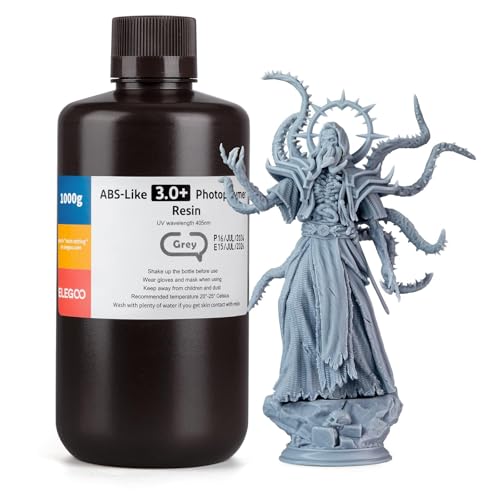
Best for: models exposed to higher temperatures or mechanical stress, where maintaining shape matters. The ABS-like formulation offers high heat resistance, reducing deformation under warmth and during post-curing processes.
Why it was selected: It balances high precision with heat tolerance, making it a reliable choice for users printing functional parts or display pieces that might see warmer environments or prolonged curing.
Limitations: The grey color can limit the ability to assess surface color uniformity before painting. It may also require careful calibration for color-fidelity-focused projects.
SUNLU 14K ABS-Like 3D Printer Resin

Best for: users seeking high-detail miniatures with robust surface finish. The 14K ABS-like resin emphasizes toughness and precision, delivering strong prints with smooth surfaces ideal for display minis that require a refined look.
Why it was selected: Low shrinkage and high precision contribute to accurate details on small features, while the material’s resilience supports easier painting and handling during tabletop play.
Limitation: Availability of color options may be limited to grey tones, which could affect certain color workflows or final painting approaches.
phrozen Aqua Snow-Gray 8K

Best for: ultra-detail display models, busts, and miniatures requiring extremely fine textures. Aqua Snow-Gray 8K is optimized for 8K LCD printers, ensuring micro-details and sharp edges are faithfully captured.
Why it was selected: The ultra-high detail capability supports professional-looking miniatures for collectors or high-end display pieces. It also features a low odor and manageable viscosity for home studios and classrooms.
Limitations: Premium resins can come at a higher cost, and users must ensure their printer is compatible with 405 nm ultraviolet curing and requires precise exposure settings for optimal results.
Teenzee Mini 3D Printed Animals (100pcs)

Best for: bulk miniatures and decorative kits, especially for fairy garden themes or non-standard display pieces. This selection offers a wide variety of small animal figures with gradient coloring for visual interest.
Why it was selected: For hobbyists building dioramas or subscribing to colorful miniature assortments, these pieces provide easy, ready-to-pinish options, expanding the creative palette beyond standard minis.
Limitations: They are not targeted for high-detail character minis or complex sculpts; color variation comes from the gradient finish rather than precise resin performance.
Buying Guide: Key Purchase Considerations
What level of detail do you need?
For ultra-fine textures on busts or display minis, choose resins marketed for high resolution, such as 8K-capable formulas. If durability for gaming minis is the priority, select a resin with strong impact resistance and long-term stability.
Is heat resistance or flexibility important?
ABS-like resins offer higher heat resistance and mechanical resilience. If you expect models to warm slightly or to be durable during handling, these are good options.
What printer compatibility matters?
Ensure the resin matches your printer’s wavelength (typically 405 nm) and is tested for your printer family (for example, 8K/16K LCD printers or standard SLA/DLP units). Check post-processing requirements such as washing solvents and curing times.
What color outcomes are you aiming for?
Grey resins are common starting points and paint-friendly, but if you need vivid colors straight from printing, look for resins with strong pigmentation or plan to apply post-coloring after curing.
Budget and post-processing
Premium resins often deliver crisper details and better surface finishes but may cost more per liter. Consider your budget alongside required post-processing, including washing and post-curing equipment.
Practical comparison tips
- Choose best for detail when you need crisp textures and fine lines in small minis.
- Choose better for durability when minis see frequent handling or shipping.
- Avoid resins with limited color options if you plan immediate painting without extensive coloring work.
FAQ
- What resin is best for 8K miniatures? — Resins marketed for ultra-high detail and 8K readiness, like Aqua Snow-Gray 8K, are ideal for highly detailed pieces.
- Is grey resin suitable for painting? — Yes. Grey resins are a common base for painting; they typically accept primer and paint well.
- Can I mix resins for different parts of a model? — Mixing resins is generally not recommended due to different curing properties; use a single resin type per print where possible.
- Do I need post-processing equipment? — For best results, a resin printer setup often requires washing with isopropyl alcohol and a UV curing station to achieve a smooth, durable finish.
- Are high-heat resins necessary for table-top minis? — For regular tabletop use, heat resistance is helpful, but most hobby prints perform well with standard curing regimes.
- Which resin should I buy for large batches? — Consider durability and cost-per-liter; resins marketed for gaming minis often balance cost with adequate strength for mass production.
Leave a Reply