Best Acrylic Model Paint Sets for Hobbyists and Artists
Yes, you should choose acrylic model paint sets that offer vibrant colors, smooth flow, and compatibility with your surfaces. This guide highlights top 5 sets that balance coverage, mixability, and long-term finish for beginners and seasoned painters alike. Each choice targets a different use-case: detailed miniature work, airbrush-ready projects, or broad coverage on dioramas and terrain. The buyer will benefit from straightforward color ranges, included thinner for blending, and clear guidance on best application scenarios.
Summary table of selected products:
| Product | Color Range | Thinner Included | Best For |
|---|---|---|---|
| Nicpro 18 Colors Model Paint Set | 18 colors + metallics | Yes | Beginners and detailed mini work on plastics and figures |
| Nicpro 30 Colors Model Paint Set | 30 colors + 4 metallics | Yes | Professional and advanced blending, airbrush work |
| Smallbudi 20 Colors Model Paint Set | 20 colors + thinner | Yes | All-in-one kit for hobbyists, miniatures, and 3D prints |
| X ARTY HUB Model Paint Set | 20 colors | No (brush-ready system) | Beginner-friendly, even coverage for quick results |
| Nicpro 10 Colors WWII U.S. Model Paint Set | 11 pieces (10 colors + thinner) | Yes | Armor and infantry projects with camo and detail work |
Nicpro 18 Colors Model Paint Set

The Nicpro 18 Colors Set provides a compact range of 18 colors plus metallics and a thinner. It is designed for brush application with smooth flow and strong adhesion on plastic, resin, wood, and metal. This set supports both detailing and full coverage on miniatures, figures, and dioramas. The included thinner helps with blending and airbrush-ready work. Best for beginners and hobbyists who want a ready-to-use starter palette with reliable performance. Limitations: the set emphasizes essential tones; expanding to metallics or additional shades may be needed for complex schemes.
Nicpro 30 Colors Model Paint Set

This 33-piece set expands to 30 colors plus four metallics and three thinners, making it versatile for detailed layering, glazing, and airbrush work. The paints are formulated for plastic, resin, wood, and metal surfaces with durable, lightfast finishes. Metallic shades like gold, silver, gunmetal, and bronze add depth for armor and mechanical details. Choose this for mid- to advanced-level projects and for users who want robust finishing options. Caution: handling may require more storage space and organization due to larger color range.
Smallbudi 20 Colors Model Paint Set

The Smallbudi kit offers 20 colors plus three detail brushes and one thinner. It emphasizes complete coverage with strong opacity and a refined matte finish once dry. The set is designed for models, miniatures, 3D prints, and dioramas, with blends suitable for skin tones, shadows, metallics, and base colors. Best for hobbyists who want an all-in-one solution and hands-on tools for precise painting. Limitation: brushes provided may be lightweight for heavy-duty surfaces or very large areas.
X ARTY HUB Model Paint Set
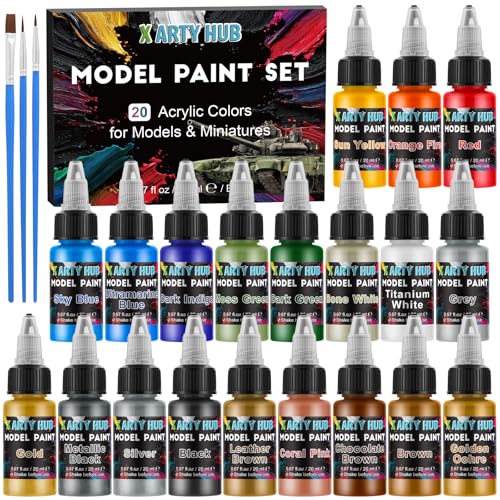
The X ARTY HUB set focuses on beginner-friendly, pre-mixed standard colors that enable realistic lighting and shading with minimal effort. It emphasizes exceptional coverage with most coatings requiring only 1–2 coats while preserving fine details. This kit is ideal for new painters or quick tabletop results on plastic, resin, and metal miniatures. Caution: avoid overloading brushes to prevent spilling or pooling on delicate surfaces.
Nicpro 10 Colors WWII U.S. Model Paint Set

This set targets WWII U.S.-style armor and infantry projects with ten colors plus thinner. It provides smooth, even flow for fine brushwork and basecoats, enabling precise panel lines, edges, and broad coverage. Best for armor enthusiasts and figurine painters focusing on camo and field gear. Better for period-specific color schemes; however, it offers fewer colors than larger sets, which may require mixing to achieve certain hues.
Buying Guide
What should I consider when choosing acrylic model paints?
Color range and finish are primary concerns. Decide between matte or metallic emphasis and whether you need extra metallics for weathering or battle-damage effects. Higher pigment load typically yields better opacity with fewer coats.
Do I need thinners or airbrush compatibility?
If you plan airbrushing or long blending sessions, select sets that include thinners. Thinners improve flow, reduce tip-drying, and help achieve smooth transitions. Brush-only painters may not need thinners, but they can still improve consistency.
What surfaces will I paint on?
Quality sets state adhesion on plastic, resin, wood, and metal. For miniatures and dioramas, ensure pigments are compatible with your surface and that you can achieve fine detail without sacrificing coverage.
How important is color accuracy and lightfastness?
Look for UV-resistant pigments and reliable opacity. Lightfastness helps ensure painted models don’t fade under display lighting over time.
Is an all-in-one kit worth it?
All-in-one kits with brushes and thinner are convenient for beginners and casual hobbyists. They reduce setup time and provide a cohesive set of tools to start painting right away, though color variety may be narrower than larger sets.
Practical tips for selecting a paint set
- Pick a kit with a mix of base colors, skin tones, and metallics for versatile projects.
- Consider the number of colors relative to your project scope—smaller kits suit entry-level modeling, larger kits suit ongoing campaigns.
- Check whether the included brushes are appropriate for the level of detail you target.
FAQ
- Q: Are these paints safe for kids? A: Most sets are non-toxic and designed for hobby use, but supervision is recommended for younger children.
- Q: Can I use these paints with an airbrush without thinning? A: Some sets include thinners for airbrushing; thinning is often necessary for consistent spray patterns.
- Q: Will these paints scratch easily after drying? A: Properly dried acrylics form a durable matte finish, but chipping may occur on heavily handled models unless sealed with varnish.
- Q: How many coats are typically needed for solid color? A: Most colors reach good opacity in 1–2 coats, depending on the surface and pigment strength.
- Q: Can I mix colors between sets? A: Yes, acrylics mix well; using compatible thinner helps with consistent blends.
- Q: Is a primer required before painting? A: For best adhesion on certain plastics, applying a primer or base coat can improve results.
Leave a Reply