Best Epoxy Resin for Knife Handles: Durable, DIY-Friendly Options
Choosing the right epoxy resin is essential for knife handle projects, balancing bonding strength, flexibility, and work time. The following picks are among the most popular epoxy resins designed for knife handles and related woodworking and metal applications. Each option offers varying cure times, toughness, and adhesion to handle substrates like wood, metal, and composites. Read on to compare characteristics and find the best fit for your knife build or repair project.
| Product | Type / Key Benefit | Typical Working Time |
|---|---|---|
| Bob Smith Industries BSI-205 Slow-Cure | Extended working time; high strength | About 30 minutes |
| Forge Bond Knife Handle Epoxy Adhesive | Versatile, 1:1 mix; good for full/hidden tangs | Typically 5–10 minutes setup, longer cure |
| Provspro Knife Handle Epoxy | Durable, A&B 2-part; clear and high impact | 24-hour cure |
| WEST SYSTEM G/flex Epoxy | Waterproof bonding; good on damp woods | Workable within a few minutes |
| GORILLA 2 Part Epoxy | Easy to use; 5-minute set; clear finish | About 5 minutes |
When selecting epoxy for knife handles, consider the substrate compatibility (wood, metal, composites), the required impact resistance, and whether you need a clear finish for aesthetics. The options below span slow-cure, high-adhesion, and easy-to-use formulations to suit hobbyists and professionals alike. Each product section provides practical details to help you decide which resin aligns with your project timeline, tool access, and finishing goals.
Bob Smith Industries BSI-205 Slow-Cure Epoxy
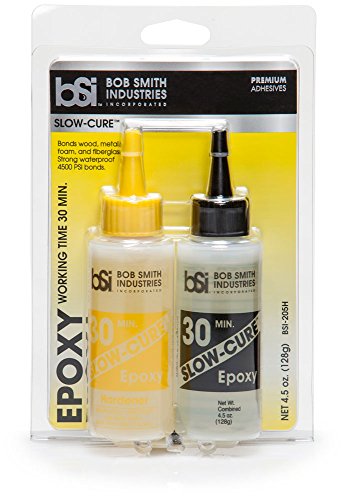
BSI-205 Slow-Cure epoxy offers a generous 30-minute working window, making it suitable for precise alignment and larger handle projects. The extended working time reduces rushed placement when shaping handle scales or aligning inlays. Once cured, it forms a tough, impact-resistant bond essential for load-bearing joints in knife handles. This formulation provides reliable adhesion across multiple substrates, including wood, fiberglass, metal, glass, ceramics, and many plastics. The combination of work time and strong final properties helps accommodate both full and partial tang handles, as well as repairs where alignment accuracy matters.
For knife builders who engage in detailed shaping or inlay work, the slow-curing nature can minimize mistakes and improve surface finishes. The resin’s clear appearance helps maintain a clean, professional look on light woods or colored handle materials. Drying times are suitable for projects where multiple steps, such as securing pins or rivets, are performed before final polishing. While not the fastest option, BSI-205 is a dependable choice for extended-handling projects that require careful control over the bonding process.
Notable considerations include proper surface preparation, clamping, and ensuring the resin is mixed to a uniform consistency. Users should follow safety guidelines for dust control and ventilation, especially when working with cured resin or sanding to final shape. The product’s versatility across substrates means it can be used not only for traditional wood handles but also for hybrid builds with metal or composite components.
Forge Bond Knife Handle Epoxy Adhesive

Forge Bond Knife Handle Epoxy Adhesive is designed for both full tang and hidden tang knife applications. Its 1:1 mix ratio simplifies measuring and mixing, enabling quick setup and straightforward use for knife handles made from a range of materials including non-ferrous metals and steels. The product emphasizes high impact and fracture resistance, aiming to maintain a durable bond under repeated use and stress. This makes it well-suited for custom handles, repairs, or specialty inlays where a robust, mixed substrate bond is essential.
The adhesive’s flexibility and elongation lend resilience to changes in temperature or minor substrate movement, which can be advantageous for handles subject to heat generated during use or repeated handling. It’s versatile enough for various tang configurations, whether you’re crafting push tang, hidden tang, or rat tail configurations. The clear resin helps maintain aesthetic appeal on light woods or dyed handle scales, while its cured hardness supports a rigid, secure grip.
Application considerations include thorough surface prep, proper clamping, and a clean 1:1 mix to ensure uniform curing. As with similar epoxies, avoid moisture exposure during initial cure if possible to prevent surface defects. Overall, Forge Bond presents a practical balance of ease-of-use and strong performance for knife handle projects demanding dependable adhesion across multiple materials.
Provspro Knife Handle Epoxy Kit

Provspro Knife Handle Epoxy is a two-part A&B resin kit designed for knife handle applications, featuring clear resin with high impact resistance. The product emphasizes adhesion to a wide range of materials, including non-ferrous metals and stainless steels, making it suitable for both new handles and repairs. A 24-hour cure time offers flexibility for multi-day projects, allowing you to plan steps such as drilling, shaping, and final finishing with a stable bond in between sessions. The kit’s clarity supports superior aesthetics for transparent or lightly tinted handle materials.
This epoxy’s combination of rigidity and toughness supports both traditional full tang and modern handle designs. Its formulation aims to deliver a reliable bond under stress while maintaining enough elongation to absorb shocks without brittle failure. The clear resin is particularly advantageous for users who want to showcase natural wood grains or vibrant handle composites without orange peel or yellowing post-cure.
Practically, ensure accurate measurement of resin and hardener, adequate ventilation, and precise mixing to achieve a uniform cure. The handling and clamping steps are essential for achieving flush scales and smooth finished faces. Provspro offers a robust option for knife makers who seek a balance between ease of use and performance on tough substrates.
WEST SYSTEM G/flex Epoxy (2 x 4 oz)

West System G/flex epoxy is engineered for permanent waterproof bonding and is noted for its tenacious adhesion to difficult-to-glue woods, including tropical hardwoods. This makes it particularly appealing for knife handles that use exotic woods or damp substrates. G/flex can bond to wood that remains slightly damp, and it remains effective in challenging environments where traditional epoxies might falter. It is a versatile choice for crafts and repairs that require long-term stability in variable moisture and temperature conditions.
The formulation emphasizes durability under wet or humid conditions, which is useful for outdoor or workbench projects exposed to moisture. For knife handles, this epoxy can help secure dense hardwoods and mixed-material handles where exposure to moisture or humidity could occur post-assembly. The resin’s capability to bond damp surfaces reduces prep time when working with unfinished or freshly cut wood.
As with all epoxies, proper mixing, surface preparation, and clamping are essential for an optimal bond. G/flex’s workability window and cure profile should be planned around your project timeline, especially when integrating additional hardware or decorative elements. This option is well-suited to handle designs that benefit from robust waterproof bonding and resilient performance in tough environments.
GORILLA 2 Part Epoxy, Clear
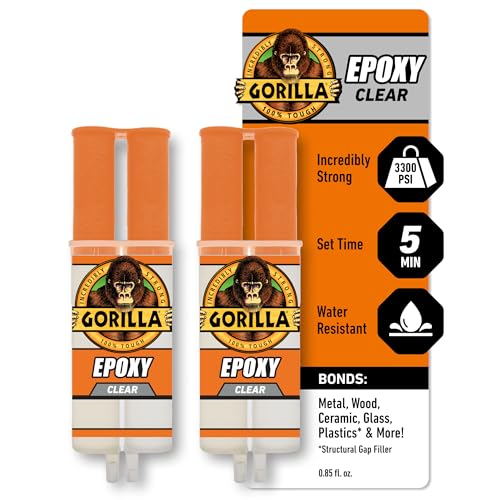
Gorilla 2 Part Epoxy is a user-friendly, clear epoxy with a 5-minute set time. This makes it a practical option for knife handle projects that require quick handling and repositioning before full cure. The resin is designed to form a strong bond and provides gap-filling capabilities, which can be advantageous when dealing with irregularities in handle shapes or mismatched components. The clear finish supports clean aesthetics, especially for knives where the handle material is visually prominent.
One of Gorilla’s strengths is its straightforward application process, making it suitable for hobbyists and professionals who want predictable results with minimal setup. The quick set time supports rapid iterations, which is helpful during design experiments or when multiple prototypes are being tested. Keep in mind that faster cure times require careful clamping and workspace organization to prevent shift or misalignment before the bond fully sets.
For best results, ensure the surfaces are clean and dry, and mix resin and hardener thoroughly. Temperature and humidity can affect cure time and final strength, so plan your project accordingly. Gorilla’s epoxy offers a reliable balance of ease-of-use and durable performance for everyday knife handle fabrication and repair tasks.
Buying Guide: Key Purchase Considerations for Knife Handle Epoxies
Substrate compatibility matters: Wood, metal, and composite handles each have different bonding requirements. Look for resins that explicitly mention adhesion to wood and metals if your project includes steel or aluminum components.
Working time vs. cure time: Slow-curing formulations provide longer alignment windows but may extend project completion. Fast-curing epoxies save time but require quicker setup and precise handling. Match the resin to your workflow and tolerance for handling delays.
Viscosity and gap-filling: For intricate handle designs with inlays or fills, a lower-viscosity resin that flows into gaps can prevent air pockets. Some epoxies offer gap-filling properties to address uneven surfaces without needing extra filler.
Clamping and fixtures: Good clamping strategy is essential with any epoxy. Plan for fixtures that hold scales, pins, or hardware flush while the resin cures. Consider reusable forms or jigs to improve consistency across batches.
Durability and heat resistance: Handles endure heat during use and exposure to environmental conditions. Epoxies with higher impact resistance and stability under temperature fluctuations help preserve bond integrity over time.
Finish and aesthetics: If you want a crystal-clear, high-gloss appearance, verify anti-yellowing properties and clarity after cure. Some resins are optimized for transparency, while others prioritize speed or strength over appearance.
Safety and handling: Always work in a well-ventilated area, wear gloves, and follow manufacturer guidelines for mixing ratios, pot life, and disposal. Proper ventilation reduces exposure to fumes during mixing and sanding after cure.
Cost and availability: Availability of the exact formulation and the cost per project may influence your choice. Consider buying a kit with multiple components or additional accessories if you frequently work on knife handles.
Leave a Reply