Best Laser for Wood Engraving: Top Picks for Precise Woodworking
Choosing the right laser engraver for wood helps hobbyists and professionals achieve clean lines, fine detail, and repeatable results. This guide showcases five prominent models tailored for wood engraving, highlighting their precision, speed, and ease of use. Each option supports wood as a primary material, with capabilities spanning engraving, cutting, and versatile project support. Explore practical features, ensure compatibility with your workspace, and compare performance to decide which laser best fits your wood projects.
| Product | Laser Power | Working Area | Key Strength | URL |
|---|---|---|---|---|
| ACMER S1 Laser Engraver (6000mW) | 6000 mW | 130×130 mm | Ultra-fine accuracy; fast engraving | Product Link |
| LONGER Ray5 (5W) | 5000 mW | 400×400 mm | High-speed, large workspace | Product Link |
| ACMER S1 Laser Engraver (3500mW) | 3500 mW | 130×130 mm | Detailed engraving with beginner setup | Product Link |
| LONGER Ray5 (10W) | 10000 mW | 400×400 mm | Multi-attachment kit; high precision | Product Link |
| Carverall K15 Pro (5W) | 5000 mW | 200×300 mm | Beginner-friendly with high accuracy | Product Link |
ACMER S1 6000mW Laser Engraver

The ACMER S1 6000mW model delivers ultra-fine accuracy with a 2mm focal length and a wavelength around 455 nm. It offers up to 10,000 mm/min engraving speed and repeatable positioning to 0.01 mm. This dual-function device handles engraving and cutting on wood, bamboo, leather, acrylic, and more. It ships largely preassembled, enabling quick setup and fast project starts for beginners and professionals alike.
LONGER Ray5 5W Laser Engraver

Equipped with a 5W laser and a 400×400 mm workspace, the Ray5 5W provides robust engraving capabilities on wood, metal, and acrylic. A 0.08×0.08 mm laser point and 0.01 mm engraving accuracy enable intricate patterns with reliable repeatability. The device supports offline use and features a 3.5-inch touchscreen, enhancing user control for varied wood projects and designs.
ACMER S1 3500mW Laser Engraver

The 3500mW ACMER S1 balances precision and affordability, with similar 0.01 mm repeatable accuracy and a 2 mm focal length. It supports engraving on multiple materials including wood, acrylic, and metal oxide ceramics, making it suitable for DIY artisans and small business projects. Preassembly helps reduce setup complexity for new users while preserving professional-grade results on wood surfaces.
LONGER Ray5 10W Engraver Kit
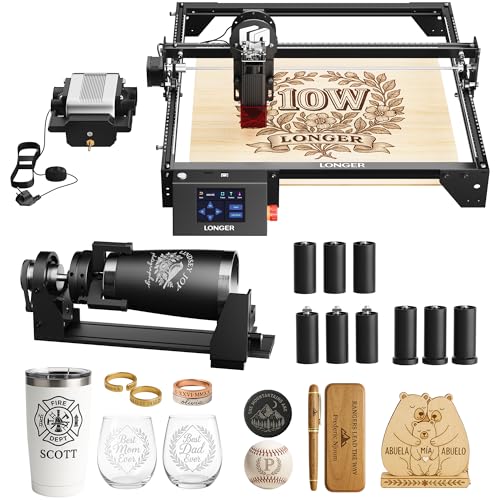
The Longer Ray5 10W model expands capabilities with a larger 400×400 mm area and an air assist rotary kit. It supports high-speed engraving (up to 10,000 mm/min) and uses a 0.06 mm laser spot for crisp results. The included accessories—air pump, rotary attachment, and risers—enable engraving on cylindrical items and taller pieces, broadening woodwork possibilities.
Carverall K15 Pro 5W Engraver
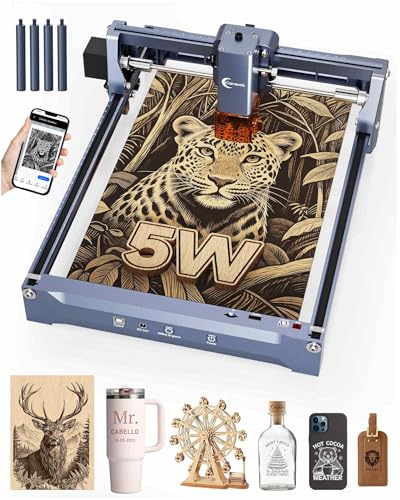
The Carverall K15 Pro offers true 5W output and a compact 200×300 mm engraving area. It emphasizes beginner-friendly setup with a quick 90-second assembly and software compatibility with CutLabX, LightBurn, and LaserGRBL. The model delivers high-precision engraving up to 0.01 mm and speeds around 15,000 mm/min, suitable for wood crafts, jewelry detailing, and decorative items.
Buying Guide: Wood Engraving Laser Considerations
- Power and material compatibility: Higher wattage enables deeper cuts and faster processing on hardwoods, but may be overkill for thin plywood or laser-etched veneers. For wood engraving, 3.5W–10W covers most hobbyist and professional needs.
- Working area: Choose a size that fits typical projects. Large-format beds (e.g., 400×400 mm) support bigger panels and repeated designs, while compact units excel at small decor pieces and personalized gifts.
- Engraving precision: Look for sub-0.02 mm repeatable positioning if your work relies on fine detail. A stable chassis and quality optics help maintain consistency across sessions.
- Material versatility: If you plan to engrave other materials (acrylic, leather, metal oxide ceramics), verify the machine supports multi-material engraving and recommended speeds.
- Software compatibility: Ensure the laser works with common design tools (LightBurn, LaserGRBL) and offers offline operation if network access is limited.
- Ease of setup and maintenance: Preassembled units save time and reduce learning curves. Check for safety features, alignment aids, and readily available replacement parts.
- Accessories and expandability: Optional air assist, rotary attachments, and additional risers can broaden your project range, especially for cylindrical items and thicker materials.
- Safety: Class II/1 laser systems require appropriate safety measures, eye protection, and ventilation considerations to protect users during long sessions.
When selecting a laser for wood engraving, balance project size, material variety, and available workspace. The options above provide a spectrum from compact, beginner-friendly units to larger, feature-rich systems. Review your typical project types, required precision, and whether you value a robust software ecosystem or hardware expandability to identify the best fit for your woodworking goals.
Leave a Reply