Best Laser Engravers for Wood Projects and Precision Cutting
If you’re turning wood into art, signage, or custom gifts, a reliable laser engraver can elevate your workflow. This guide highlights five top options tailored for wood engraving and precise cutting, featuring models from ACMER and other trusted brands. Learn what to compare—power, accuracy, working area, and ease of use—and how to choose the right device for your home shop or small business needs.
Summary of chosen products
| Product | Brand | Laser Power | Working Area | Key Strength |
|---|---|---|---|---|
| ACMER S1 Laser Engraver (3500mW) | ACMER | 3500mW | 130×130 mm | High precision with fast engraving |
| ACMER S1 Laser Engraver (6000mW) | ACMER | 6000mW | 130×130 mm | Maximum power for deeper cuts |
| ACMER S1 Laser Engraver (2500mW) | ACMER | 2500mW | 130×130 mm | Balanced power and precision |
| Canon Color imageCLASS LBP646Cdw | Canon | Monochrome/Color (laser) | Standard office size | Color capability for proofs and signage |
| HP Color LaserJet Pro MFP 3301sdw | HP | Color laser | Office size | All-in-one functionality for office tasks |
ACMER S1 Laser Engraver, 3500mW

The ACMER S1 3500mW laser engraver excels at fine wood engraving and precise cutting with a 130×130 mm working area. It uses a 455±5 nm diode laser and a 2 mm focal length to deliver high-precision results, with a claimed repeatable positioning accuracy of 0.01 mm and engraving speeds up to 10,000 mm/min. This model supports engraving on wood, bamboo, leather, plastic, PCB substrates, ceramics, and more, making it suitable for DIY projects, crafts, and small-scale production. It ships mostly preassembled, reducing setup time for beginners and hobbyists.
Key features include:
– 3500 mW diode laser power for depth and detail
– 36 W machine output with a 2 mm focal length
– 455 nm wavelength for clean, crisp results
– 130×130 mm working area
– 0.01 mm repeatable positioning accuracy
Ideal use cases: detailed wood engravings, decorative items, small signs, and light cutting tasks on thin plywood or acrylic. The device’s beginner-friendly setup and quick start make it appealing for makers who want fast, reliable results with minimal learning curve.
ACMER S1 Laser Engraver, 6000mW

The ACMER S1 with 6000 mW laser power delivers deeper cutting and faster material removal on wood and other substrates, while keeping its 130×130 mm working area. It maintains the same 455±5 nm wavelength and 2 mm focal length for precision, with a claimed engraving speed up to 10,000 mm/min and 0.01 mm repeatable accuracy. This model is designed to tackle thicker or harder woods and provides versatility for more demanding engraving and light-cutting tasks.
Key features include:
– 6000 mW diode laser power
– 48 W machine output
– Fast engraving speeds and high accuracy
– 2 mm focal length, 455 nm wavelength
– 130×130 mm working area
Best suited for: deeper engravings, denser woods, and projects that require more aggressive material removal while preserving fine detail. The machine’s plug-and-play approach continues to suit beginners who want higher performance with minimal setup.
ACMER S1 Laser Engraver, 2500mW
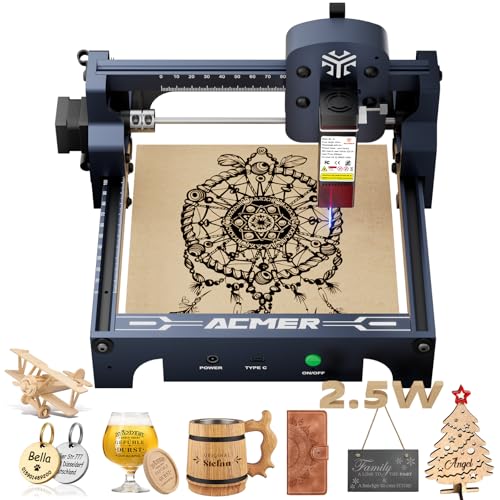
The 2500mW ACMER S1 balances power and precision for wood projects, offering a 130×130 mm working area, 2 mm focal length, and a 455±5 nm diode laser. With the same target speed of up to 10,000 mm/min and 0.01 mm repeatable positioning, this model provides a practical option for hobbyists and small-business users who need dependable results without pushing into higher-powered settings. It also features a straightforward, quick-start assembly that minimizes setup time.
Highlights:
– 2500 mW laser power
– 130×130 mm working area
– 2 mm focal length
– 455 nm wavelength
– Beginner-friendly assembly
Effective for: decorative wood plaques, personalized items, and precise line work on thin boards and veneers. This variant offers a comfortable middle ground for those who need precise engraving without the extra amplification of power.
Buying Guide: Key Purchase Considerations For Wood Engraving
When choosing a laser engraver for wood, consider the following factors to ensure you pick a model that fits your projects and budget:
- Power and material depth: Higher wattage (3500–6000 mW) can handle darker woods and deeper engravings, but may increase cost and require more careful ventilation. For thin plywood and veneer, lower power often suffices.
- Working area: A 130×130 mm area is common for desktop units and suits small to medium pieces. If you work on larger panels, look for a larger bed or modular modules.
- Precision and speed: Look for a laser with fast engraving speed (toward 10,000 mm/min) and sub-0.02 mm repeatability for crisp results on intricate designs.
- Ease of use: Preassembled or semi-assembled machines reduce setup time. User-friendly software compatibility and straightforward focus adjustment help beginners.
- Material compatibility: Ensure the device supports wood, bamboo, leather, acrylic, and other substrates you plan to engrave. Some units mention ceramics or glass as secondary capabilities.
- Safety and ventilation: Laser engravers require proper ventilation and eye protection. Check for enclosure features or recommended safety accessories from the manufacturer.
- Maintenance and support: Look for readily available replacement parts, firmware updates, and responsive customer support to minimize downtime.
- Price-to-performance balance: Higher power often means greater capability but higher cost. Assess your typical project size and required depth to select a model that delivers best value.
Compared to traditional CNC routers, laser engravers offer precision engraving with less mechanical noise and a smaller footprint, but they require appropriate understanding of material burn characteristics and air assistance. For wood crafting, selecting a model with reliable focal accuracy, stable power output, and solid software support is essential to achieve repeatable results.
Leave a Reply