Best Lead Solder for Stained Glass: Strong, Bright Joints for Your Projects
Choosing the right solder is essential for stained glass work, balancing melting point, flow, and bond strength. This guide highlights five top-selling options and compares their core features to help you select the best fit for copper foil and lead-based techniques.
| Product | Brand | Key Benefit |
|---|---|---|
| Canfield 60/40 solder | Canfield | Made in USA; virgin material; classic tin/lead alloy |
| AIM Artist Pure Lead-Free Solder | AIM | Lead-free with silver-bearing alloy; high-temp flow |
| 60/40 Solder for Stained Glass, ANOSON | ANOSON | High-purity Sn60/Pb40; precise alloy for copper foil |
| Lead-Free Solder Sn99.3/Cu0.7 | YEZHET | RoHS compliant; minimal lead exposure |
| HGMZZQ 60/40 solder for stained glass | HGMZZQ | Industrial-grade; 60/40 with no flux; 3mm diameter |
Canfield 60/40 Solder for Stained Glass

- Made in the USA; 1 lb spool
- Virgin material; 60/40 Tin/Lead
- Melting temperature: 360° – 376°F
AIM Artist Pure Lead-Free Solder, 0.125 Inch

- Lead-free alloy with high-purity silver bearing
- Eutectic melting point: 407°F-439°F
- Strong bond with excellent flow for bright beads
60/40 Solder for Stained Glass, ANOSON

- Sn60/Pb40 alloy; 3mm diameter; 1 lb spool
- High-purity; designed for copper foil work
- Promotes seamless, consistent joints
Lead-Free Solder Sn99.3/Cu0.7 (YeZhet)

- Sn99.3/Cu0.7; 1 lb spool; 3.0mm diameter
- RoHS compliant; low lead exposure
- Melting around 422.6°F; flux-free (use flux separately)
HGMZZQ 60/40 Solder for Stained Glass

- Sn60/Pb40; 3 mm diameter; 1 lb spool
- No flux; suitable for glass art and crafts
- Melting point ~361°F (183°C)
AIM Artist Pure 50/50 Solder, 0.125 Inch

- 50/50 Tin/Lead; 361°F – 413°F melting range
- Designed for both beginners and experienced artisans
- 0.125 inch diameter; 1 lb spool
2.0mm Lead Free Solder Wire (No Flux) – ENERSYSTEC
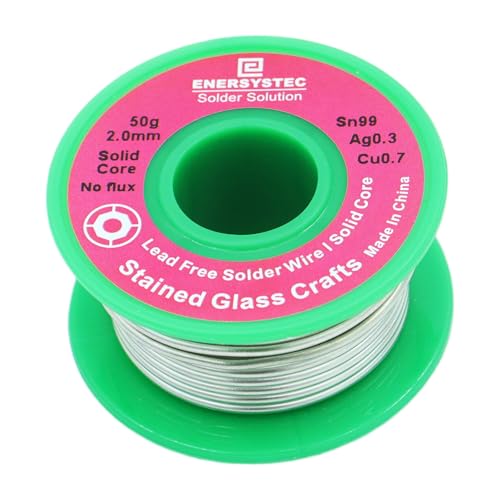
- Sn99 Ag0.3 Cu0.7; no flux core
- 2.0 mm diameter; bright, smooth joints
- Requires flux for optimal flow; RoHS compliant
2.0mm Lead Free Solder Wire (No Flux) – ENERSYSTEC

- Sn99 Ag0.3 Cu0.7; 0.08″ diameter; 100g
- No flux; requires flux for best flow
- RoHS compliant; bright solder joints
Buying Guide
- Alloy composition: Traditional stained glass uses Sn-Pb 60/40 for easy flow and strong joints, while lead-free options (Sn-Cu-Ag) reduce health concerns but may require flux or different temperatures.
- Melting point and flow: Check the stated melting range. A narrower range (e.g., 360–376°F) helps predict soldering behavior and easier cleanup.
- Flux considerations: Some solder comes flux-free; you’ll need a compatible flux to ensure bright, smooth joints and to prevent oxidation.
- Diameter and package: Common diameters are 0.125″ (3 mm). Larger spools (1 lb) suit ongoing projects; smaller spools are convenient for beginners.
- RoHS and safety: Lead-free options reduce exposure. If using lead-based solder, work in a well-ventilated area and follow safety guidelines.
- Artistic goals: For copper foil work, consistent bead size and color consistency are important. Consider alloys with good flow and stable joints for intricate designs.
- Availability and compatibility: Ensure the solder matches your copper foil technique and flux type. Some artists prefer a specific melting range to match their torch or soldering iron.
Leave a Reply