Best Pencils for Realistic Drawing
For realistic drawing, choosing the right pencils can make shaded textures, fine details, and lifelike tonal ranges easier to achieve. This guide highlights five top options that suit different artists—from beginners to professionals. Use these picks to study texture, line weight, and blending with confidence. The buyer profiles below explain who each product is best for and why it stands out for realistic shading and detail work.
| Product | Brand | Best For | Why It Stands Out |
|---|---|---|---|
| Drawing Realistic Textures in Pencil | Penguin | Editors, students, and artists seeking foundational texture techniques | Classic reference for texture realism with practical exercises |
| Faber-Castell Graphite Sketch Pencil Set | Faber-Castell | Beginners to intermediate artists needing reliable range | Versatile six-piece set with break-resistant lead |
| MARKART Professional Drawing Sketching Pencil Set | MARKART | Serious hobbyists and pros who want a full hardness spectrum | 14 pencils across soft to hard grades for detailed shading |
| GETFOO Drawing Sketching Pencil Set 21 Pack | GETFOO | Artists who want a comprehensive toolkit with extras | Includes multiple accessories for shading and blending |
Drawing Realistic Textures in Pencil

Best for: texture-focused learning and foundational realism. This paperback guides artists through rendering surface textures, a core skill for convincing realism in drawings. The book’s concise pages suit students and self-tudiers who prefer clear, actionable steps rather than theory-heavy content.
What to know: The edition details indicate a compact, accessible format suitable for study sessions and reference. It is a good starting point for artists building texture vocabulary before tackling more complex subjects.
Caution: This book is a resource, not a complete drawing kit. It should be paired with practice pencils and paper for best results.
Faber-Castell Graphite Sketch Pencil Set

Best for: beginners to intermediate artists who want a reliable, compact set with varied hardness. The 2H, HB, B, 2B, 4B, and 6B range supports light sketching through deep shading, making it a flexible starting point for realistic work.
Why selected: Faber-Castell’s pencils emphasize smooth laydown, comfortable grip, and break-resistant lead, which helps maintain consistent shading as you refine textures. The hexagonal ergonomic design reduces hand fatigue during longer sessions.
Caution: The set is small; advanced shading may require additional softer or harder pencils beyond this six-pack for nuanced tonal control.
MARKART Professional Drawing Sketching Pencil Set
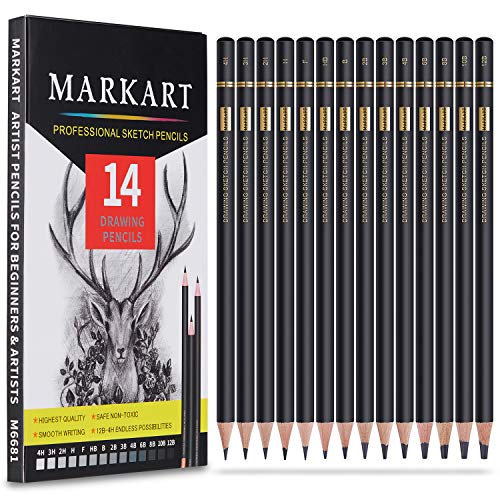
Best for: artists who want a broad hardness spectrum and professional-grade performance. This 14-piece set covers from 12B to 4H, enabling deep shadows and fine light details for realistic portraits and landscapes.
Why selected: The set emphasizes a wide tonal range and reliable lead quality, supporting expressive shading and precise textures. It’s ideal for practitioners aiming for more nuanced realism in their sketches.
Caution: Pencils can be densely pigmented; beginners may need practice to avoid over-smoothing or smudging when learning texture rendering.
GETFOO Drawing Sketching Pencil Set 21 Pack

Best for: artists who want a complete toolkit with shading and blending tools, plus extra accessories. The 21-piece configuration covers a wide range of graphite grades and includes white charcoal, blending stumps, and erasers for depth and texture work.
Why selected: This kit offers breadth and versatility, making it a practical all-in-one option for realistic drawing. The included tools support smooth transitions from mid-tones to fine details, aiding texture realism.
Caution: The abundance of accessories can be overwhelming for absolute beginners. Start with core pencils and gradually incorporate extras as skills grow.
Buying Guide: Key Considerations For Realistic Pencil Art
- Hardness range: For realistic shading, look for sets that span from hard (H, 2H) to very soft (6B, 8B, 12B). Hard pencils create fine lines and light tones, while soft pencils yield rich blacks and broad tones for textures.
- Lead quality and break resistance: Break-resistant cores reduce interruptions during shading. Look for pencils with strong clay-graphite composition and secure lead binding.
- Grip and comfort: Ergonomic designs and hexagonal shapes help maintain control during long sessions, improving precision in texture work.
- Page compatibility: For realistic textures, consider the paper type and grain. Smooth papers respond well to fine line work, while textured papers reveal richer grain in shading.
- Included tools: Sets with blending stumps, erasers, and white charcoal can improve blending, highlights, and texture detail when drawing realistically.
- Ease of sharpening: Consistent, easy sharpening preserves edge quality for sharp textures and fine details without crumbling the lead.
FAQ
- What pencil hardness is best for realistic portraits?
Use a range from 2H to 6B. Hard pencils (H to 2H) help with fine lines and light shading, while softer pencils (4B to 6B) produce deeper tones needed for realistic skin tones and textures.
- Should beginners start with a full set or focused набор?
A focused six- or eight-piece set is often better to learn control and tone progression before expanding to a larger collection.
- Is blending essential for realism in pencil art?
Blending helps create smooth transitions between tones, but over-blending can reduce texture. Use stumps and a light touch to preserve texture details.
- What paper type works best with graphite realism?
Smooth drawing paper and specialized graphite paper yield clean lines and even shading, while lightly textured paper can enhance perceived texture in fabrics and skin.
- Can I achieve photo-realistic textures with standard graphite pencils?
Yes, with a combination of careful value control, layering, and precise textures. Start with light tones and gradually build depth, paying attention to direction and surface texture.
- Do erasers matter for realism?
Yes. Precision erasers, kneaded erasers, and white erasers help create highlights and correct small texture details without leaving smudges.
Leave a Reply