Best 3D Resin Print Primers and Coatings for Flawless Finishes
Answering the needs of resin-printer users, a primer or coating can greatly improve surface quality, moisture resistance, and paint adhesion. This guide highlights five reliable options and explains who benefits most from each. Ideal for hobbyists seeking smoother finishes, professionals requiring durable protective layers, and first-time resin printers aiming for easier post-processing.
| Product | Best For |
|---|---|
| kuailaya 3D Print Primer | Moisture protection and strong adhesion on nylon, PETG, and related materials |
| Mshunya 3D Print Coating | Clear, smooth epoxy coating for surface finish and waterproofing |
| Siraya Tech Aegis Clear | Moisture barrier and base layer for FDM and resin parts |
| Smooth-On XTC-3D | General coating for SLA/SLS and other rigid prints |
| 52 Pcs Resin 3D Printing Tool Kit | Post-processing tools for model finishing and cleanup |
kuailaya 3D Print Primer

Features include deep waterproof sealing that blocks moisture and prevents warping, superior adhesion to Nylon, PPA, PET, and PETG, and a quick-drying water-based formula. The primer is designed for easy application with a brush and natural curing. This makes it suitable for printers using FDM materials as well as certain fiber-reinforced blends.
Best for: Hobbyists and small studios needing a moisture barrier and reliable adhesion on multiple thermoplastic substrates. Choose this if you want a simple, brush-on coating that improves surface integrity without specialized equipment.
Limitation: The product data favors Nylon/PETG compatibility; test on unfamiliar blends before full-scale use to avoid unexpected adhesion results.
Mshunya 3D Print Coating

This kit provides a clear epoxy coating that smooths surfaces, improves strength and detail, and adds waterproof protection. The set includes a 3:1 A/B epoxy kit plus accessories, offering a complete, ready-to-use solution for finishing resin-printed parts. The self-leveling properties help minimize brush marks for a uniform topcoat.
Best for: Crafters and modelers seeking a single-box coating with strong smoothing characteristics and waterproof results. Better for projects where a flawless, glossy finish is desired straight from the kit.
Caution: Epoxy coatings require careful mixing and proper curing conditions; follow included instructions to avoid uneven cures or surface imperfections.
Siraya Tech Aegis Clear
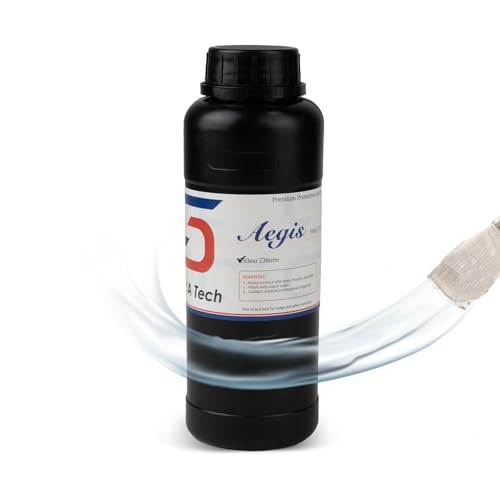
Designed as a moisture barrier and base coat, Aegis Clear encapsulates fibers and seals surface pores to preserve strength. It also serves as a leveling base for paints and topcoats, improving adhesion for subsequent finishes. The water-based formula is noted for being skin-friendly during handling of composite prints.
Best for: Printers using Nylon or other hygroscopic filaments, and anyone wanting a reliable primer that improves final paint or epoxy adhesion. It’s particularly useful when surface texture needs smoothing before finishing coats.
Limitation: As a base layer, it is most effective when applied as a thin coat; heavy applications may not cure uniformly across complex geometries.
Smooth-On XTC-3D Coating

High-performance coating designed to smooth and finish 3D printed parts. Works well on SLA, SLS, PLA, ABS, and other rigid media, and cures to an impact-resistant, transparent finish. The product provides a uniform film with relatively short cure times and a hard surface suitable for painting or post-processing.
Best for: Projects needing a robust, clear topcoat with excellent leveling and minimal brush marks. Particularly advantageous for mixed-material prints where a uniform surface is critical.
Limitation: Cure time and viscosity may require mixing and careful application to avoid running or pooling on vertical surfaces.
52 Pcs Resin 3D Printing Tool Kit

Comprehensive post-processing kit with stainless steel funnels and filters, scrapers, tweezers, knives, sanding sticks, and other finishing tools. The kit facilitates resin handling, model removal, resin recovery, and surface finishing, helping achieve cleaner, higher-quality results.
Best for: Professionals and hobbyists who want a complete set of tools to streamline post-processing. Choose this if you value organized workflows and minimizing material loss during cleanup.
Limitation: This kit focuses on tools rather than coatings; use in tandem with primers or coatings for best results on resin prints.
Buying Guide
What to consider when choosing a resin print primer or coating
- Material compatibility: Check which filaments the product advertises (Nylon, PETG, PA, etc.).
- Moisture protection: If you print with hygroscopic materials, a moisture barrier helps prevent warping and loss of strength.
- Finish quality: For painting or topcoats, a leveling base or self-leveling coating reduces brush marks and improves adhesion.
- Application ease: Water-based primers are typically easier to use; epoxy coatings may require precise mixing.
- Cure time and handling: Consider working time, drying periods, and post-curing requirements before handling finished parts.
- Toolkit support: If the project involves extensive post-processing, a tool kit can save time and reduce waste.
Frequently Asked Questions
- What is the primary role of a 3D print primer for resin parts?
To improve adhesion for paints or topcoats, fill micro-pores, and provide a moisture barrier for stability.
- Can I use a standard epoxy resin coating on resin prints?
Yes, many epoxies are suitable, but follow the product’s mixing ratios and cure times to avoid defects.
- Is a moisture barrier necessary for all resin prints?
Not always, but it helps when prints use hygroscopic materials or will be stored in humid environments.
- Are these primers compatible with all 3D printing methods?
Most targets are specific to resin and certain FDM surfaces; verify compatibility before use.
- What is the advantage of a leveling epoxy coating?
It reduces brush marks, improves surface continuity, and provides a uniform base for paints or topcoats.
- Do I need a dedicated post-processing kit when using primers?
While not required, a comprehensive kit can speed up cleanup and ensure consistent results.
Leave a Reply