Best Tools for Abstract Painting: Textures, Stencils and Scrapers
Abstract painting thrives on texture, spontaneity, and diverse marks. The following hand-picked tools—from silicone brushes to textured scrapers and palette knives—help you build layers, push paint, and experiment with forms. Each pick is evaluated for versatility, build quality, and how easily it fits different surfaces like canvas, paper, or board. Use these to expand your abstract vocabulary and experiment with movement, pattern, and depth.
Summary of selected products
| Product | Brand | Key Use | Notable Benefit |
|---|---|---|---|
| Princeton Catalyst Tools, Wedge | Princeton | Texturizing and moving paint | Engineered silicone blades for heavy-bodied media |
| Outus Silicone Painting Brushes | Outus | Applying texture gels and moving paint | Flat pointed edge for precision and squeegee-like action |
| YAFIYGI Textured Art Scrapers | YAFIYGI | Texture patterns and layered color | Varied blade shapes for depth and patterns |
| 30 Pcs Abstract Layering Stencils | EYUNSTAR | Stencil-based abstraction and patterning | Reusable and washable plastic templates |
| MTQY 7 in 1 Swipe Tools | MTQY | Acrylic pouring and swiping | Multiple serrations and a brush for texture and waves |
Princeton Catalyst Tools for Texturizing and Moving Paint

The Princeton Catalyst Tools pair wedge blades designed for handling heavy-bodied paints, plaster, and clay. With engineered silicone blades, these tools enable sculptural marks and bold textures that are especially useful in abstract compositions. The Wedge No. 1 enables controlled edge work and broad movements across a painted surface, making it easier to create organic textures or large-scale passages without leaving visible tool lines. The ergonomic handle and sturdy construction help maintain consistent texture across sessions, essential for developing a cohesive abstract piece.
Features at a glance include compatibility with high-viscosity materials and the ability to move paint with precision. The tools excel when you want to push, pull, or carve through wet layers to reveal underlying color interactions. For mixed media work, they also support light scoring or dragging to establish initial rhythms, which is valuable in composition planning for abstracts.
In terms of technique, these catalyst tools are ideal for adding dimension through layering and for creating sculptural elements in your painting. They work well with gels, modeling pastes, and texture mediums that require more resistance than a standard brush can provide. By using the wedges, artists can craft subtle transitions or pronounced textures, contributing to a dynamic surface that invites close inspection.
Outus Silicone Painting Brushes for Texture and Move

The Outus 2 Pieces Silicone Painting Brush set includes a 1-inch and a 2-inch brush designed to apply gels, paste, and textures with minimal brush marks. The flat pointed edged tip allows precision when applying gels or working with stencils, enabling clean edges and controlled material distribution. These brushes function well as color shapers—smoothing, lifting, and moving paint across a canvas or panel, while avoiding brush fibers in the final surface. They can serve as squeegees for pulling paint evenly and reducing waste in large areas.
From a texture perspective, these silicone tools excel at creating flat, even layers and soft transitions. They are particularly useful for techniques requiring quick blending and removal of excess paint where a traditional brush may leave streaks. They also clean easily, which supports iterative experimentation during a session focused on abstract layering. When used with acrylics, gels, or water-based media, the brushes help achieve a variety of surface feels—from slick to matte—depending on paint viscosity and pressure.
Practical considerations include ensuring the tool edge remains sharp enough to pull consistent lines and keeping the surface free of hair or fibers. The absence of bristles helps prevent unintended texture artifacts, making these brushes a reliable option for clean, repeatable textures in an abstract workflow. They pair well with stencils or masking techniques to create crisp boundaries within a broader, textured field.
YAFIYGI 7Pcs Textured Scrapers for Abstract Art

YAFIYGI offers a seven-piece set of textured scrapers in assorted shapes designed to add depth and variation to abstract paintings. The variety supports a broad range of textures—from bold, sweeping marks to fine, etched lines. The plastic blades are lightweight, enabling quick, repeated passes across wet paint to build up layers without fatigue. The set is suitable for acrylics, oils, and mixed media; artists can sculpt through pastes or apply color with different scraping angles to generate diverse surfaces.
These scrapers facilitate experimentation with layering and pattern creation. The distinct blade shapes let you explore controlled negative space, rhythmic repetitions, and edge-based marks that interact with underlying color. They are easy to clean, store, and reuse, making them a practical addition for studios focused on process-based abstraction. Given their versatility, the scrapers can also be used in collage-inspired abstracts to reveal glimpses of lower layers, enhancing visual complexity.
EYUNSTAR 30 Pcs Abstract Layering Stencils
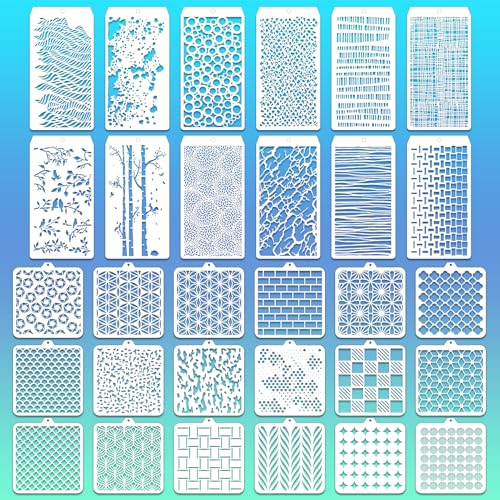
This stencil set offers 30 unique patterns in two sizes, expanding the potential for abstract layering. The stencils are made from durable plastic, designed to be reusable and washable, making them suitable for multiple sessions. By providing a range of geometric and organic motifs, these templates assist in introducing structure to otherwise freeform works, creating contemplative balance between planned shapes and spontaneous paint behavior.
In practice, these stencils help artists quickly introduce rhythm and repetition, which is essential in many abstract compositions. They support spray painting, light brushing, and the layering of multiple passes to build texture and depth. The ability to reuse them repeatedly reduces material waste, which is a practical advantage for ongoing experimentation. The two sizes allow for both focal centers and broader patterned fields within a single piece.
MTQY 7 in 1 Pouring Swipe Tools with Brush

MTQY’s seven-piece tool set is designed for acrylic and oil painters who explore pouring and swipe techniques. The assortment includes serrated and smooth edges plus a dedicated brush, enabling a range of applications from wave-like swirls to linear motion. The variety supports experimentation with different drag angles, speeds, and paint viscosities to produce dynamic, fluid abstracts. The brushes’ inclusion also helps blend or lift while maintaining control over where pigment is deposited, contributing to a balanced composition.
The supplied shapes are optimized for creating consistent wave patterns and sweeping lines. When combined with different medium densities, you can achieve layered effects that mimic natural textures such as water, rock striations, or marbled surfaces. The tools’ ergonomic design aids in long sessions, minimizing hand fatigue while preserving precision across multiple passages.
HSYMQ 10Pcs Dotting Tools for Mandala and Texture

These 10 dotting tools include 20 ball-end options across 14 diameters, suitable for dotting on rocks, canvases, seashells, or gourds. The assortment supports precise point work in mandala patterns, stippling textures for abstract fields, and embossing in clay or plaster contexts. The tools are lightweight plastic with no sharp edges, reducing the risk of accidental cuts during extended sessions. They resist rust and stains, maintaining stability across multiple uses and media types.
In abstract painting, these dots can function as focal points or contribute to a tessellated, dotted texture that evolves as paint layers dry. The ability to swap sizes quickly encourages explorations of scale relationships within a piece. The tools are well-suited for both controlled dot work and looser, exploratory patterns, enabling a broad spectrum of assembler-like or organic textures in your artwork.
LIGHTWISH 5-Piece Painting Knives Set

The LIGHTWISH 5-piece stainless steel palette knife set features durable, flexible blades with ergonomic wooden handles. The knives are designed for versatility across oil, acrylic, and mixed media, supporting color mixing, scraping, and texture creation. The stainless steel blades provide resilience against wear, while the ergonomic handles reduce hand fatigue during extended sessions. Different blade shapes enable a range of strokes—from broad swipes to fine lines—helping artists vary texture and mark-making in abstract work.
These knives are particularly valuable for layering, scraping away glaze areas to reveal underlayers, or carving through soft mediums to reveal contrasting colors. The combination of sturdy construction and comfortable grip ensures consistency throughout a painting session. For abstract projects, using multiple knives can create a varied surface texture and a richer sense of depth, as different tools produce distinct marks within the same composition.
Buying Guide for Abstract Painting Tools
- Material compatibility: Consider whether you work with acrylics, oils, gels, pastes, or mixed media. Tools with silicone or stainless steel blades suit heavy media and gels, while plastic scrapers work well for lighter layers and textures.
- Texture goals: Decide if you want broad, sweeping textures or intricate, stippled patterns. A mix of wedges, scrapers, and dotting tools offers broad creative latitude.
- Edge control: Tools with sharp, pointed edges support precise lines and edges; avoid tools with sharp points if you work mostly with soft, build-up textures.
- Reuse and cleanup: Reusable plastic stencils and silicone tools are easy to clean and resuable, supporting ongoing experimentation while reducing waste.
- Ergonomics and fatigue: For longer sessions, prioritize tools with comfortable handles and balanced weight to prevent hand strain.
- Surface compatibility: Ensure tools are suitable for the painting surface you use—canvas, panel, paper, or board may respond differently to each tool type.
- Maintenance: Clean tools after use to prevent drying and sticking of paint. Some tools perform better with occasional conditioning for long-term longevity.
Leave a Reply