Best Filler for Plastic Models: Top Picks for Seamless Repairs and Detailing
Whether you’re filling seams, repairing nicks, or smoothing surfaces before painting, choosing the right filler for plastic models makes all the difference. This guide covers top options that balance ease of use, sanding ability, and finish quality for hobbyists and builders. The selections below are best for model builders seeking reliable, paint-ready results without complicated steps. A quick buyer’s table follows to help you compare essentials at a glance.
| Product | Best For | Key Benefit |
|---|---|---|
| Vallejo Plastic Putty 20 ml | General model repair and detailing | Opaque, sandable acrylic paste |
| ULTWAT High-Density Gap Filling Putty | Acrylic model kits and military figures | Non-shrinking, sandable, fast-drying |
| FUNCRECOL UV Light Curing Putty 50g | Quick repairs and tight gaps | Ultra-fast cure under UV light |
| TAMIYA USA TAM87053 Putty Basic Type | Standard model smoothing | Trusted brand with accessible formulation |
| Perfect Plastic Putty, 40ml | Invisible seams and easy cleanup | Water-cleanup, hides seams effectively |
Note: Each product listed is suitable for plastic models, with variations in curing time, texture, and finish. Use the one that aligns with your project timeline, working environment, and preferred painting schedule.
Vallejo Plastic Putty 20 ml

Vallejo Plastic Putty is a white acrylic paste with marble powder that dries to a hard, opaque surface. It’s primarily used in model production and restoration, relief tracing, and surface decoration. It’s suitable for filling and restitution of parts and is easy to work, sand, and paint over. Best for hobbyists who want a straightforward, sanding-friendly option that yields a solid, paint-ready finish. A potential limitation is that it may require careful application to avoid creating visible texture if overworked.
Who it’s best for: Beginners and intermediate builders needing an easy-to-sand white putty for seams and small gaps.
Why chosen: It offers a reliable, opaque fill with a consistent finish and broad compatibility with paint systems.
Caution: Work in thin layers to avoid buildup that requires excessive sanding.
ULTWAT High-Density Gap Filling Putty

ULTWAT’s professional-grade filler is designed to fill gaps, seams, and imperfections on plastic or resin models, military kits, and figurines. It dries to a hard, sandable finish without shrinking or cracking. It’s compatible with acrylic, enamel, and lacquer paints, and is easy to apply with a spatula or brush. It’s best for detailed work where a solid, durable fill is needed over longer modeling sessions. A caveat is that curing time can vary with thickness.
Who it’s best for: More experienced builders tackling larger seams or challenging gaps where a durable, sandable finish matters.
Why chosen: Strong, non-shrinking performance that accepts multiple paint types, making it versatile for varied projects.
Caution: Apply in thin layers to avoid overfilling and extended sanding time.
FUNCRECOL UV Light Curing Putty 50g

FUNCRECOL’s UV-curing putty offers fast repair with a curing time under one minute when exposed to UV light (365-405 nm). The toothpaste-like consistency makes it easy to apply, and it cures with minimal shrinkage. It’s suitable for fixing scratches, chips, cracks, and pinholes on a wide range of surfaces including resin, plastic, wood, and stone. Best for quick fixes and detailed work where speed is essential. A limitation is the need for a UV light source to achieve full cure.
Who it’s best for: Builders who need rapid fixes and tight tolerances for detailing work.
Why chosen: The ultra-fast cure enables same-day progress, reducing downtime between steps.
Caution: Requires a UV light for curing; plan work area to accommodate curing time and light access.
FUNCRECOL UV Light Curing Putty for Model Kits 50g
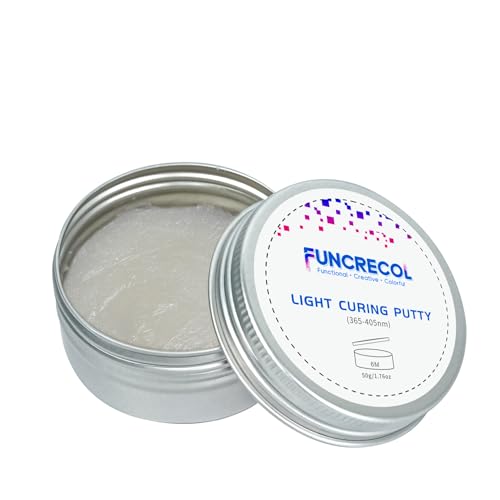
This FUNCRECOL product highlights a high-hardness and strength after UV curing, reaching an 85D hardness rating for durable repairs and detailing. It is designed for filling, repairing, and welding parts, and remains easy to work, sand, and paint after curing. It’s best for projects requiring a robust, hard finish that resists handling wear. The main limitation is its dependence on UV curing for final strength and surface smoothness.
Who it’s best for: Builders needing rigid, snap-free repairs and durable detailing on small to medium gaps.
Why chosen: Combines fast UV curing with a hard, paint-ready surface for crisp model details.
TAMIYA USA TAM87053 Putty Basic Type

TAMIYA’s TAM87053 PuttyBasic Type is a staple option from a well-known model maker. It’s marketed for general smoothing tasks and seam filling, with the brand’s USA-based production approach noted in the listing. It’s best for hobbyists seeking a reliable, familiar tool in a straightforward formulation. A potential limitation is variability across batches, so testers may want to perform a small sample before larger use.
Who it’s best for: Builders who prefer a trusted, readily available putty from a mainstream brand.
Why chosen: Consistent brand availability and predictable performance for routine smoothing tasks.
Caution: Availability and consistency can vary by batch; test a small area first.
Delux Materials Perfect Plastic Putty 40ml

Perfect Plastic Putty by Best Price Square is a 40ml option marketed as a high-quality filler with water cleanup. It’s part of the Delux Materials family, noted for seamless seam creation and easy cleanup. This option can be advantageous for quick cleanup and a smooth coat before painting. A limitation is that it may require multiple thin layers to fully hide larger imperfections.
Who it’s best for: Builders wanting easy cleanup and effective seam hiding in a solvent-free, water-washable formula.
Why chosen: The water-cleanup feature simplifies cleanup, making it convenient for beginners and casual hobbyists.
Buying Guide: Key Considerations For Filler Selection
What type of model filler should you choose? Consider curing time, finish texture, sanding requirements, and compatibility with paints you plan to use. For quick fixes, UV-curing putties can save time, but require a light source. For general building and smoothing, solvent-free acrylic putties are safer indoors and easier to clean up. If you want a near-invisible seam, look for a formula designed to minimize texture and shrinkage.
Texture And Sandability: What matters?
Texture affects how much sanding is needed. A smooth, consistent paste yields fewer steps after curing. Assess whether you prefer a rigid, hard finish or a more flexible, sandable surface. For model kits with fine details, a putty that sands easily without gouging is ideal.
Curing Time and Handling: How fast is fast enough?
Some fillers cure in minutes under UV light, while others require hours to reach handling strength. Plan your workflow: curing speed can reduce standstill time, but you’ll need equipment for UV curing and careful ventilation for solvent-based products.
Compatibility: Will it play well with paints?
Most hobby putties work with acrylic, enamel, and lacquer paints. Cross-check the product’s listed compatibility to avoid adhesion issues, peeling, or surface cracking after painting.
Best For Your Project Type
For intricate detailing and quick can’t-wait repairs, UV-curing putty options are advantageous. For standard seam filling and smoothing, acrylic putties from trusted brands provide reliable performance and easy cleanup. If you’re new to modeling, a beginner-friendly putty with straightforward instructions and accessible supplies is a smart start.
FAQ
- What is the best filler for precision gaps in plastic models? A high-density, non-shrinking filler that sands smoothly, such as the ULTWAT option, is well-suited for precision gaps.
- Can I use UV-curing putty without a UV lamp? No. UV-curing putties require a UV light source to achieve full cure and maximum hardness.
- Is acrylic putty paint-ready after sanding? Yes, acrylic putties typically accept paint after sanding, provided the surface is clean and smooth.
- Are there water-cleanup putties? Yes. Some products, like Perfect Plastic Putty, offer water-cleanup, which simplifies cleanup.
- Is it necessary to prime before filling? Priming before filler application is optional but can help you gauge how well the filler will blend with the surface and paint later.
- Which filler is best for beginners? A user-friendly acrylic putty with easy cleanup and predictable sanding is recommended for beginners.
Leave a Reply